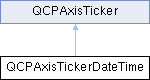
Specialized axis ticker for calendar dates and times as axis ticks. More...
Public Member Functions | |
| QCPAxisTickerDateTime () | |
| Constructs the ticker and sets reasonable default values. | |
| QString | dateTimeFormat () const |
| Qt::TimeSpec | dateTimeSpec () const |
| void | setDateTimeFormat (const QString &format) |
| Sets the format in which dates and times are displayed as tick labels. | |
| void | setDateTimeSpec (Qt::TimeSpec spec) |
| Sets the time spec that is used for creating the tick labels from corresponding dates/times. | |
| void | setTickOrigin (double origin) |
| Sets the tick origin (see QCPAxisTicker::setTickOrigin) in seconds since Epoch (1. | |
| void | setTickOrigin (const QDateTime &origin) |
| Sets the tick origin (see QCPAxisTicker::setTickOrigin) as a QDateTime origin. | |
 Public Member Functions inherited from QCPAxisTicker Public Member Functions inherited from QCPAxisTicker | |
| QCPAxisTicker () | |
| Constructs the ticker and sets reasonable default values. | |
| TickStepStrategy | tickStepStrategy () const |
| int | tickCount () const |
| double | tickOrigin () const |
| void | setTickStepStrategy (TickStepStrategy strategy) |
| Sets which strategy the axis ticker follows when choosing the size of the tick step. | |
| void | setTickCount (int count) |
| Sets how many ticks this ticker shall aim to generate across the axis range. | |
| void | setTickOrigin (double origin) |
| Sets the mathematical coordinate (or "offset") of the zeroth tick. | |
| virtual void | generate (const QCPRange &range, const QLocale &locale, QChar formatChar, int precision, QVector< double > &ticks, QVector< double > *subTicks, QVector< QString > *tickLabels) |
| This is the method called by QCPAxis in order to actually generate tick coordinates (ticks), tick label strings (tickLabels) and sub tick coordinates (subTicks). | |
Static Public Member Functions | |
| static QDateTime | keyToDateTime (double key) |
| A convenience method which turns key (in seconds since Epoch 1. | |
| static double | dateTimeToKey (const QDateTime dateTime) |
| This is an overloaded member function, provided for convenience. It differs from the above function only in what argument(s) it accepts.A convenience method which turns a QDateTime object into a double value that corresponds to seconds since Epoch (1. | |
| static double | dateTimeToKey (const QDate date) |
| This is an overloaded member function, provided for convenience. It differs from the above function only in what argument(s) it accepts.A convenience method which turns a QDate object into a double value that corresponds to seconds since Epoch (1. | |
Protected Types | |
| enum | DateStrategy { dsNone , dsUniformTimeInDay , dsUniformDayInMonth } |
Protected Member Functions | |
| virtual double | getTickStep (const QCPRange &range) Q_DECL_OVERRIDE |
| virtual int | getSubTickCount (double tickStep) Q_DECL_OVERRIDE |
| virtual QString | getTickLabel (double tick, const QLocale &locale, QChar formatChar, int precision) Q_DECL_OVERRIDE |
| virtual QVector< double > | createTickVector (double tickStep, const QCPRange &range) Q_DECL_OVERRIDE |
| Protected Member Functions inherited from QCPAxisTicker | |
| virtual double | getTickStep (const QCPRange &range) |
| virtual int | getSubTickCount (double tickStep) |
| virtual QString | getTickLabel (double tick, const QLocale &locale, QChar formatChar, int precision) |
| virtual QVector< double > | createTickVector (double tickStep, const QCPRange &range) |
| virtual QVector< double > | createSubTickVector (int subTickCount, const QVector< double > &ticks) |
| virtual QVector< QString > | createLabelVector (const QVector< double > &ticks, const QLocale &locale, QChar formatChar, int precision) |
| void | trimTicks (const QCPRange &range, QVector< double > &ticks, bool keepOneOutlier) const |
| double | pickClosest (double target, const QVector< double > &candidates) const |
| double | getMantissa (double input, double *magnitude=0) const |
| double | cleanMantissa (double input) const |
Protected Attributes | |
| QString | mDateTimeFormat |
| Qt::TimeSpec | mDateTimeSpec |
| enum QCPAxisTickerDateTime::DateStrategy | mDateStrategy |
| Protected Attributes inherited from QCPAxisTicker | |
| TickStepStrategy | mTickStepStrategy |
| int | mTickCount |
| double | mTickOrigin |
Additional Inherited Members | |
| Public Types inherited from QCPAxisTicker | |
| enum | TickStepStrategy { tssReadability , tssMeetTickCount } |
| Defines the strategies that the axis ticker may follow when choosing the size of the tick step. More... | |
Detailed Description
Specialized axis ticker for calendar dates and times as axis ticks.

This QCPAxisTicker subclass generates ticks that correspond to real calendar dates and times. The plot axis coordinate is interpreted as Unix Time, so seconds since Epoch (January 1, 1970, 00:00 UTC). This is also used for example by QDateTime in the toTime_t()/setTime_t() methods with a precision of one second. Since Qt 4.7, millisecond accuracy can be obtained from QDateTime by using QDateTime::fromMSecsSinceEpoch()/1000.0. The static methods dateTimeToKey and keyToDateTime conveniently perform this conversion achieving a precision of one millisecond on all Qt versions.
The format of the date/time display in the tick labels is controlled with setDateTimeFormat. If a different time spec (time zone) shall be used, see setDateTimeSpec.
This ticker produces unequal tick spacing in order to provide intuitive date and time-of-day ticks. For example, if the axis range spans a few years such that there is one tick per year, ticks will be positioned on 1. January of every year. This is intuitive but, due to leap years, will result in slightly unequal tick intervals (visually unnoticeable). The same can be seen in the image above: even though the number of days varies month by month, this ticker generates ticks on the same day of each month.
If you would like to change the date/time that is used as a (mathematical) starting date for the ticks, use the setTickOrigin(const QDateTime &origin) method overload, which takes a QDateTime. If you pass 15. July, 9:45 to this method, the yearly ticks will end up on 15. July at 9:45 of every year.
The ticker can be created and assigned to an axis like this:
- Note
- If you rather wish to display relative times in terms of days, hours, minutes, seconds and milliseconds, and are not interested in the intricacies of real calendar dates with months and (leap) years, have a look at QCPAxisTickerTime instead.
Constructor & Destructor Documentation
◆ QCPAxisTickerDateTime()
| QCPAxisTickerDateTime::QCPAxisTickerDateTime | ( | ) |
Constructs the ticker and sets reasonable default values.
Axis tickers are commonly created managed by a QSharedPointer, which then can be passed to QCPAxis::setTicker.
Member Function Documentation
◆ createTickVector()
|
protectedvirtual |
Reimplemented from QCPAxisTicker.
◆ dateTimeToKey() [1/2]
|
static |
This is an overloaded member function, provided for convenience. It differs from the above function only in what argument(s) it accepts.A convenience method which turns a QDate object into a double value that corresponds to seconds since Epoch (1.
Jan 1970, 00:00 UTC). This is the format used as axis coordinates by QCPAxisTickerDateTime.
- See also
- keyToDateTime
◆ dateTimeToKey() [2/2]
|
static |
This is an overloaded member function, provided for convenience. It differs from the above function only in what argument(s) it accepts.A convenience method which turns a QDateTime object into a double value that corresponds to seconds since Epoch (1.
Jan 1970, 00:00 UTC). This is the format used as axis coordinates by QCPAxisTickerDateTime.
The accuracy achieved by this method is one millisecond, irrespective of the used Qt version (it works around the lack of a QDateTime::toMSecsSinceEpoch in Qt 4.6)
- See also
- keyToDateTime
◆ getSubTickCount()
|
protectedvirtual |
Reimplemented from QCPAxisTicker.
◆ getTickLabel()
|
protectedvirtual |
Reimplemented from QCPAxisTicker.
◆ getTickStep()
|
protectedvirtual |
Reimplemented from QCPAxisTicker.
◆ keyToDateTime()
|
static |
A convenience method which turns key (in seconds since Epoch 1.
Jan 1970, 00:00 UTC) into a QDateTime object. This can be used to turn axis coordinates to actual QDateTimes.
The accuracy achieved by this method is one millisecond, irrespective of the used Qt version (it works around the lack of a QDateTime::fromMSecsSinceEpoch in Qt 4.6)
- See also
- dateTimeToKey
◆ setDateTimeFormat()
| void QCPAxisTickerDateTime::setDateTimeFormat | ( | const QString & | format | ) |
Sets the format in which dates and times are displayed as tick labels.
For details about the format string, see the documentation of QDateTime::toString().
Newlines can be inserted with "\n".
- See also
- setDateTimeSpec
◆ setDateTimeSpec()
| void QCPAxisTickerDateTime::setDateTimeSpec | ( | Qt::TimeSpec | spec | ) |
Sets the time spec that is used for creating the tick labels from corresponding dates/times.
The default value of QDateTime objects (and also QCPAxisTickerDateTime) is Qt::LocalTime. However, if the date time values passed to QCustomPlot (e.g. in the form of axis ranges or keys of a plottable) are given in the UTC spec, set spec to Qt::UTC to get the correct axis labels.
- See also
- setDateTimeFormat
◆ setTickOrigin() [1/2]
| void QCPAxisTickerDateTime::setTickOrigin | ( | const QDateTime & | origin | ) |
Sets the tick origin (see QCPAxisTicker::setTickOrigin) as a QDateTime origin.
This is useful to define the month/day/time recurring at greater tick interval steps. For example, If you pass 15. July, 9:45 to this method and the tick interval happens to be one tick per year, the ticks will end up on 15. July at 9:45 of every year.
◆ setTickOrigin() [2/2]
| void QCPAxisTickerDateTime::setTickOrigin | ( | double | origin | ) |
Sets the tick origin (see QCPAxisTicker::setTickOrigin) in seconds since Epoch (1.
Jan 1970, 00:00 UTC). For the date time ticker it might be more intuitive to use the overload which directly takes a QDateTime, see setTickOrigin(const QDateTime &origin).
This is useful to define the month/day/time recurring at greater tick interval steps. For example, If you pass 15. July, 9:45 to this method and the tick interval happens to be one tick per year, the ticks will end up on 15. July at 9:45 of every year.
The documentation for this class was generated from the following files:
- qcustomplot.h
- qcustomplot.cpp
