Specialized axis ticker suited for logarithmic axes. More...
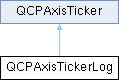
Public Member Functions | |
| QCPAxisTickerLog () | |
| Constructs the ticker and sets reasonable default values. | |
| double | logBase () const |
| int | subTickCount () const |
| void | setLogBase (double base) |
| Sets the logarithm base used for tick coordinate generation. | |
| void | setSubTickCount (int subTicks) |
| Sets the number of sub ticks in a tick interval. | |
 Public Member Functions inherited from QCPAxisTicker Public Member Functions inherited from QCPAxisTicker | |
| QCPAxisTicker () | |
| Constructs the ticker and sets reasonable default values. | |
| TickStepStrategy | tickStepStrategy () const |
| int | tickCount () const |
| double | tickOrigin () const |
| void | setTickStepStrategy (TickStepStrategy strategy) |
| Sets which strategy the axis ticker follows when choosing the size of the tick step. | |
| void | setTickCount (int count) |
| Sets how many ticks this ticker shall aim to generate across the axis range. | |
| void | setTickOrigin (double origin) |
| Sets the mathematical coordinate (or "offset") of the zeroth tick. | |
| virtual void | generate (const QCPRange &range, const QLocale &locale, QChar formatChar, int precision, QVector< double > &ticks, QVector< double > *subTicks, QVector< QString > *tickLabels) |
| This is the method called by QCPAxis in order to actually generate tick coordinates (ticks), tick label strings (tickLabels) and sub tick coordinates (subTicks). | |
Protected Member Functions | |
| virtual double | getTickStep (const QCPRange &range) Q_DECL_OVERRIDE |
| virtual int | getSubTickCount (double tickStep) Q_DECL_OVERRIDE |
| virtual QVector< double > | createTickVector (double tickStep, const QCPRange &range) Q_DECL_OVERRIDE |
| Protected Member Functions inherited from QCPAxisTicker | |
| virtual double | getTickStep (const QCPRange &range) |
| virtual int | getSubTickCount (double tickStep) |
| virtual QString | getTickLabel (double tick, const QLocale &locale, QChar formatChar, int precision) |
| virtual QVector< double > | createTickVector (double tickStep, const QCPRange &range) |
| virtual QVector< double > | createSubTickVector (int subTickCount, const QVector< double > &ticks) |
| virtual QVector< QString > | createLabelVector (const QVector< double > &ticks, const QLocale &locale, QChar formatChar, int precision) |
| void | trimTicks (const QCPRange &range, QVector< double > &ticks, bool keepOneOutlier) const |
| double | pickClosest (double target, const QVector< double > &candidates) const |
| double | getMantissa (double input, double *magnitude=0) const |
| double | cleanMantissa (double input) const |
Protected Attributes | |
| double | mLogBase |
| int | mSubTickCount |
| double | mLogBaseLnInv |
| Protected Attributes inherited from QCPAxisTicker | |
| TickStepStrategy | mTickStepStrategy |
| int | mTickCount |
| double | mTickOrigin |
Additional Inherited Members | |
| Public Types inherited from QCPAxisTicker | |
| enum | TickStepStrategy { tssReadability , tssMeetTickCount } |
| Defines the strategies that the axis ticker may follow when choosing the size of the tick step. More... | |
Detailed Description
Specialized axis ticker suited for logarithmic axes.

This QCPAxisTicker subclass generates ticks with unequal tick intervals suited for logarithmic axis scales. The ticks are placed at powers of the specified log base (setLogBase).
Especially in the case of a log base equal to 10 (the default), it might be desirable to have tick labels in the form of powers of ten without mantissa display. To achieve this, set the number precision (QCPAxis::setNumberPrecision) to zero and the number format (QCPAxis::setNumberFormat) to scientific (exponential) display with beautifully typeset decimal powers, so a format string of "eb". This will result in the following axis tick labels:

The ticker can be created and assigned to an axis like this:
Constructor & Destructor Documentation
◆ QCPAxisTickerLog()
| QCPAxisTickerLog::QCPAxisTickerLog | ( | ) |
Constructs the ticker and sets reasonable default values.
Axis tickers are commonly created managed by a QSharedPointer, which then can be passed to QCPAxis::setTicker.
Member Function Documentation
◆ createTickVector()
|
protectedvirtual |
Reimplemented from QCPAxisTicker.
◆ getSubTickCount()
|
protectedvirtual |
Reimplemented from QCPAxisTicker.
◆ getTickStep()
|
protectedvirtual |
Reimplemented from QCPAxisTicker.
◆ setLogBase()
| void QCPAxisTickerLog::setLogBase | ( | double | base | ) |
Sets the logarithm base used for tick coordinate generation.
The ticks will be placed at integer powers of base.
◆ setSubTickCount()
| void QCPAxisTickerLog::setSubTickCount | ( | int | subTicks | ) |
Sets the number of sub ticks in a tick interval.
Within each interval, the sub ticks are spaced linearly to provide a better visual guide, so the sub tick density increases toward the higher tick.
Note that subTicks is the number of sub ticks (not sub intervals) in one tick interval. So in the case of logarithm base 10 an intuitive sub tick spacing would be achieved with eight sub ticks (the default). This means e.g. between the ticks 10 and 100 there will be eight ticks, namely at 20, 30, 40, 50, 60, 70, 80 and 90.
The documentation for this class was generated from the following files:
- qcustomplot.h
- qcustomplot.cpp
