A layout that arranges child elements in a grid. More...
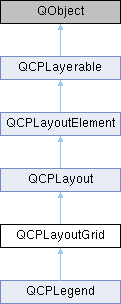
Public Types | |
| enum | FillOrder { foRowsFirst , foColumnsFirst } |
| Defines in which direction the grid is filled when using addElement(QCPLayoutElement*). More... | |
 Public Types inherited from QCPLayoutElement Public Types inherited from QCPLayoutElement | |
| enum | UpdatePhase { upPreparation , upMargins , upLayout } |
| Defines the phases of the update process, that happens just before a replot. More... | |
| enum | SizeConstraintRect { scrInnerRect , scrOuterRect } |
| Defines to which rect of a layout element the size constraints that can be set via setMinimumSize and setMaximumSize apply. More... | |
Public Member Functions | |
| QCPLayoutGrid () | |
| Creates an instance of QCPLayoutGrid and sets default values. | |
| int | rowCount () const |
| Returns the number of rows in the layout. | |
| int | columnCount () const |
| Returns the number of columns in the layout. | |
| QList< double > | columnStretchFactors () const |
| QList< double > | rowStretchFactors () const |
| int | columnSpacing () const |
| int | rowSpacing () const |
| int | wrap () const |
| FillOrder | fillOrder () const |
| void | setColumnStretchFactor (int column, double factor) |
| Sets the stretch factor of column. | |
| void | setColumnStretchFactors (const QList< double > &factors) |
| Sets the stretch factors of all columns. | |
| void | setRowStretchFactor (int row, double factor) |
| Sets the stretch factor of row. | |
| void | setRowStretchFactors (const QList< double > &factors) |
| Sets the stretch factors of all rows. | |
| void | setColumnSpacing (int pixels) |
| Sets the gap that is left blank between columns to pixels. | |
| void | setRowSpacing (int pixels) |
| Sets the gap that is left blank between rows to pixels. | |
| void | setWrap (int count) |
| Sets the maximum number of columns or rows that are used, before new elements added with addElement(QCPLayoutElement*) will start to fill the next row or column, respectively. | |
| void | setFillOrder (FillOrder order, bool rearrange=true) |
| Sets the filling order and wrapping behaviour that is used when adding new elements with the method addElement(QCPLayoutElement*). | |
| virtual void | updateLayout () Q_DECL_OVERRIDE |
| virtual int | elementCount () const Q_DECL_OVERRIDE |
| Returns the number of elements/cells in the layout. | |
| virtual QCPLayoutElement * | elementAt (int index) const Q_DECL_OVERRIDE |
| \seebaseclassmethod | |
| virtual QCPLayoutElement * | takeAt (int index) Q_DECL_OVERRIDE |
| \seebaseclassmethod | |
| virtual bool | take (QCPLayoutElement *element) Q_DECL_OVERRIDE |
| Removes the specified element from the layout and returns true on success. | |
| virtual QList< QCPLayoutElement * > | elements (bool recursive) const Q_DECL_OVERRIDE |
| Returns a list of all child elements in this layout element. | |
| virtual void | simplify () Q_DECL_OVERRIDE |
| Simplifies the layout by collapsing rows and columns which only contain empty cells. | |
| virtual QSize | minimumOuterSizeHint () const Q_DECL_OVERRIDE |
| Returns the suggested minimum size this layout element (the outerRect) may be compressed to, if no manual minimum size is set. | |
| virtual QSize | maximumOuterSizeHint () const Q_DECL_OVERRIDE |
| Returns the suggested maximum size this layout element (the outerRect) may be expanded to, if no manual maximum size is set. | |
| QCPLayoutElement * | element (int row, int column) const |
| Returns the element in the cell in row and column. | |
| bool | addElement (int row, int column, QCPLayoutElement *element) |
| This is an overloaded member function, provided for convenience. It differs from the above function only in what argument(s) it accepts.Adds the element to cell with row and column. | |
| bool | addElement (QCPLayoutElement *element) |
| This is an overloaded member function, provided for convenience. It differs from the above function only in what argument(s) it accepts.Adds the element to the next empty cell according to the current fill order (setFillOrder) and wrapping (setWrap). | |
| bool | hasElement (int row, int column) |
| Returns whether the cell at row and column exists and contains a valid element, i.e. | |
| void | expandTo (int newRowCount, int newColumnCount) |
| Expands the layout to have newRowCount rows and newColumnCount columns. | |
| void | insertRow (int newIndex) |
| Inserts a new row with empty cells at the row index newIndex. | |
| void | insertColumn (int newIndex) |
| Inserts a new column with empty cells at the column index newIndex. | |
| int | rowColToIndex (int row, int column) const |
| Converts the given row and column to the linear index used by some methods of QCPLayoutGrid and QCPLayout. | |
| void | indexToRowCol (int index, int &row, int &column) const |
| Converts the linear index to row and column indices and writes the result to row and column. | |
| Public Member Functions inherited from QCPLayout | |
| QCPLayout () | |
| Creates an instance of QCPLayout and sets default values. | |
| virtual void | update (UpdatePhase phase) Q_DECL_OVERRIDE |
| If phase is upLayout, calls updateLayout, which subclasses may reimplement to reposition and resize their cells. | |
| virtual QList< QCPLayoutElement * > | elements (bool recursive) const Q_DECL_OVERRIDE |
| Returns a list of all child elements in this layout element. | |
| virtual int | elementCount () const =0 |
| Returns the number of elements/cells in the layout. | |
| virtual QCPLayoutElement * | elementAt (int index) const =0 |
| Returns the element in the cell with the given index. | |
| virtual QCPLayoutElement * | takeAt (int index)=0 |
| Removes the element with the given index from the layout and returns it. | |
| virtual bool | take (QCPLayoutElement *element)=0 |
| Removes the specified element from the layout and returns true on success. | |
| virtual void | simplify () |
| Simplifies the layout by collapsing empty cells. | |
| bool | removeAt (int index) |
| Removes and deletes the element at the provided index. | |
| bool | remove (QCPLayoutElement *element) |
| Removes and deletes the provided element. | |
| void | clear () |
| Removes and deletes all layout elements in this layout. | |
| Public Member Functions inherited from QCPLayoutElement | |
| QCPLayoutElement (QCustomPlot *parentPlot=0) | |
| Creates an instance of QCPLayoutElement and sets default values. | |
| QCPLayout * | layout () const |
| Returns the parent layout of this layout element. | |
| QRect | rect () const |
| Returns the inner rect of this layout element. | |
| QRect | outerRect () const |
| Returns the outer rect of this layout element. | |
| QMargins | margins () const |
| QMargins | minimumMargins () const |
| QCP::MarginSides | autoMargins () const |
| QSize | minimumSize () const |
| QSize | maximumSize () const |
| SizeConstraintRect | sizeConstraintRect () const |
| QCPMarginGroup * | marginGroup (QCP::MarginSide side) const |
| QHash< QCP::MarginSide, QCPMarginGroup * > | marginGroups () const |
| void | setOuterRect (const QRect &rect) |
| Sets the outer rect of this layout element. | |
| void | setMargins (const QMargins &margins) |
| Sets the margins of this layout element. | |
| void | setMinimumMargins (const QMargins &margins) |
| If setAutoMargins is enabled on some or all margins, this function is used to provide minimum values for those margins. | |
| void | setAutoMargins (QCP::MarginSides sides) |
| Sets on which sides the margin shall be calculated automatically. | |
| void | setMinimumSize (const QSize &size) |
| Sets the minimum size of this layout element. | |
| void | setMinimumSize (int width, int height) |
| This is an overloaded member function, provided for convenience. It differs from the above function only in what argument(s) it accepts.Sets the minimum size of this layout element. | |
| void | setMaximumSize (const QSize &size) |
| Sets the maximum size of this layout element. | |
| void | setMaximumSize (int width, int height) |
| This is an overloaded member function, provided for convenience. It differs from the above function only in what argument(s) it accepts.Sets the maximum size of this layout element. | |
| void | setSizeConstraintRect (SizeConstraintRect constraintRect) |
| Sets to which rect of a layout element the size constraints apply. | |
| void | setMarginGroup (QCP::MarginSides sides, QCPMarginGroup *group) |
| Sets the margin group of the specified margin sides. | |
| virtual void | update (UpdatePhase phase) |
| Updates the layout element and sub-elements. | |
| virtual QSize | minimumOuterSizeHint () const |
| Returns the suggested minimum size this layout element (the outerRect) may be compressed to, if no manual minimum size is set. | |
| virtual QSize | maximumOuterSizeHint () const |
| Returns the suggested maximum size this layout element (the outerRect) may be expanded to, if no manual maximum size is set. | |
| virtual QList< QCPLayoutElement * > | elements (bool recursive) const |
| Returns a list of all child elements in this layout element. | |
| virtual double | selectTest (const QPointF &pos, bool onlySelectable, QVariant *details=0) const Q_DECL_OVERRIDE |
| Layout elements are sensitive to events inside their outer rect. | |
| Public Member Functions inherited from QCPLayerable | |
| QCPLayerable (QCustomPlot *plot, QString targetLayer=QString(), QCPLayerable *parentLayerable=0) | |
| Creates a new QCPLayerable instance. | |
| bool | visible () const |
| QCustomPlot * | parentPlot () const |
| QCPLayerable * | parentLayerable () const |
| Returns the parent layerable of this layerable. | |
| QCPLayer * | layer () const |
| bool | antialiased () const |
| void | setVisible (bool on) |
| Sets the visibility of this layerable object. | |
| Q_SLOT bool | setLayer (QCPLayer *layer) |
| Sets the layer of this layerable object. | |
| bool | setLayer (const QString &layerName) |
| This is an overloaded member function, provided for convenience. It differs from the above function only in what argument(s) it accepts. Sets the layer of this layerable object by name. | |
| void | setAntialiased (bool enabled) |
| Sets whether this object will be drawn antialiased or not. | |
| virtual double | selectTest (const QPointF &pos, bool onlySelectable, QVariant *details=0) const |
| This function is used to decide whether a click hits a layerable object or not. | |
| bool | realVisibility () const |
| Returns whether this layerable is visible, taking the visibility of the layerable parent and the visibility of this layerable's layer into account. | |
Protected Member Functions | |
| void | getMinimumRowColSizes (QVector< int > *minColWidths, QVector< int > *minRowHeights) const |
| void | getMaximumRowColSizes (QVector< int > *maxColWidths, QVector< int > *maxRowHeights) const |
| Protected Member Functions inherited from QCPLayout | |
| virtual void | updateLayout () |
| void | sizeConstraintsChanged () const |
| Subclasses call this method to report changed (minimum/maximum) size constraints. | |
| void | adoptElement (QCPLayoutElement *el) |
| void | releaseElement (QCPLayoutElement *el) |
| QVector< int > | getSectionSizes (QVector< int > maxSizes, QVector< int > minSizes, QVector< double > stretchFactors, int totalSize) const |
| Protected Member Functions inherited from QCPLayoutElement | |
| virtual int | calculateAutoMargin (QCP::MarginSide side) |
| virtual void | layoutChanged () |
| virtual void | applyDefaultAntialiasingHint (QCPPainter *painter) const Q_DECL_OVERRIDE |
| virtual void | draw (QCPPainter *painter) Q_DECL_OVERRIDE |
| virtual void | parentPlotInitialized (QCustomPlot *parentPlot) Q_DECL_OVERRIDE |
| Protected Member Functions inherited from QCPLayerable | |
| virtual void | parentPlotInitialized (QCustomPlot *parentPlot) |
| virtual QCP::Interaction | selectionCategory () const |
| virtual QRect | clipRect () const |
| virtual void | applyDefaultAntialiasingHint (QCPPainter *painter) const =0 |
| virtual void | draw (QCPPainter *painter)=0 |
| virtual void | selectEvent (QMouseEvent *event, bool additive, const QVariant &details, bool *selectionStateChanged) |
| virtual void | deselectEvent (bool *selectionStateChanged) |
| virtual void | mousePressEvent (QMouseEvent *event, const QVariant &details) |
| This event gets called when the user presses a mouse button while the cursor is over the layerable. | |
| virtual void | mouseMoveEvent (QMouseEvent *event, const QPointF &startPos) |
| This event gets called when the user moves the mouse while holding a mouse button, after this layerable has become the mouse grabber by accepting the preceding mousePressEvent. | |
| virtual void | mouseReleaseEvent (QMouseEvent *event, const QPointF &startPos) |
| This event gets called when the user releases the mouse button, after this layerable has become the mouse grabber by accepting the preceding mousePressEvent. | |
| virtual void | mouseDoubleClickEvent (QMouseEvent *event, const QVariant &details) |
| This event gets called when the user presses the mouse button a second time in a double-click, while the cursor is over the layerable. | |
| virtual void | wheelEvent (QWheelEvent *event) |
| This event gets called when the user turns the mouse scroll wheel while the cursor is over the layerable. | |
| void | initializeParentPlot (QCustomPlot *parentPlot) |
| void | setParentLayerable (QCPLayerable *parentLayerable) |
| bool | moveToLayer (QCPLayer *layer, bool prepend) |
| void | applyAntialiasingHint (QCPPainter *painter, bool localAntialiased, QCP::AntialiasedElement overrideElement) const |
Protected Attributes | |
| QList< QList< QCPLayoutElement * > > | mElements |
| QList< double > | mColumnStretchFactors |
| QList< double > | mRowStretchFactors |
| int | mColumnSpacing |
| int | mRowSpacing |
| int | mWrap |
| FillOrder | mFillOrder |
| Protected Attributes inherited from QCPLayoutElement | |
| QCPLayout * | mParentLayout |
| QSize | mMinimumSize |
| QSize | mMaximumSize |
| SizeConstraintRect | mSizeConstraintRect |
| QRect | mRect |
| QRect | mOuterRect |
| QMargins | mMargins |
| QMargins | mMinimumMargins |
| QCP::MarginSides | mAutoMargins |
| QHash< QCP::MarginSide, QCPMarginGroup * > | mMarginGroups |
| Protected Attributes inherited from QCPLayerable | |
| bool | mVisible |
| QCustomPlot * | mParentPlot |
| QPointer< QCPLayerable > | mParentLayerable |
| QCPLayer * | mLayer |
| bool | mAntialiased |
Additional Inherited Members | |
| Signals inherited from QCPLayerable | |
| void | layerChanged (QCPLayer *newLayer) |
| This signal is emitted when the layer of this layerable changes, i.e. | |
| Static Protected Member Functions inherited from QCPLayout | |
| static QSize | getFinalMinimumOuterSize (const QCPLayoutElement *el) |
| static QSize | getFinalMaximumOuterSize (const QCPLayoutElement *el) |
Detailed Description
A layout that arranges child elements in a grid.
Elements are laid out in a grid with configurable stretch factors (setColumnStretchFactor, setRowStretchFactor) and spacing (setColumnSpacing, setRowSpacing).
Elements can be added to cells via addElement. The grid is expanded if the specified row or column doesn't exist yet. Whether a cell contains a valid layout element can be checked with hasElement, that element can be retrieved with element. If rows and columns that only have empty cells shall be removed, call simplify. Removal of elements is either done by just adding the element to a different layout or by using the QCPLayout interface take or remove.
If you use addElement(QCPLayoutElement*) without explicit parameters for row and column, the grid layout will choose the position according to the current setFillOrder and the wrapping (setWrap).
Row and column insertion can be performed with insertRow and insertColumn.
Member Enumeration Documentation
◆ FillOrder
Defines in which direction the grid is filled when using addElement(QCPLayoutElement*).
The column/row at which wrapping into the next row/column occurs can be specified with setWrap.
- See also
- setFillOrder
| Enumerator | |
|---|---|
| foRowsFirst | Rows are filled first, and a new element is wrapped to the next column if the row count would exceed setWrap. |
| foColumnsFirst | Columns are filled first, and a new element is wrapped to the next row if the column count would exceed setWrap. |
Member Function Documentation
◆ addElement() [1/2]
| bool QCPLayoutGrid::addElement | ( | int | row, |
| int | column, | ||
| QCPLayoutElement * | element | ||
| ) |
This is an overloaded member function, provided for convenience. It differs from the above function only in what argument(s) it accepts.Adds the element to cell with row and column.
If element is already in a layout, it is first removed from there. If row or column don't exist yet, the layout is expanded accordingly.
Returns true if the element was added successfully, i.e. if the cell at row and column didn't already have an element.
Use the overload of this method without explicit row/column index to place the element according to the configured fill order and wrapping settings.
- See also
- element, hasElement, take, remove
◆ addElement() [2/2]
| bool QCPLayoutGrid::addElement | ( | QCPLayoutElement * | element | ) |
This is an overloaded member function, provided for convenience. It differs from the above function only in what argument(s) it accepts.Adds the element to the next empty cell according to the current fill order (setFillOrder) and wrapping (setWrap).
If element is already in a layout, it is first removed from there. If necessary, the layout is expanded to hold the new element.
Returns true if the element was added successfully.
- See also
- setFillOrder, setWrap, element, hasElement, take, remove
◆ columnCount()
|
inline |
Returns the number of columns in the layout.
- See also
- rowCount
◆ element()
| QCPLayoutElement * QCPLayoutGrid::element | ( | int | row, |
| int | column | ||
| ) | const |
Returns the element in the cell in row and column.
Returns 0 if either the row/column is invalid or if the cell is empty. In those cases, a qDebug message is printed. To check whether a cell exists and isn't empty, use hasElement.
- See also
- addElement, hasElement
◆ elementAt()
|
virtual |
\seebaseclassmethod
Note that the association of the linear index to the row/column based cells depends on the current setting of setFillOrder.
- See also
- rowColToIndex
Implements QCPLayout.
◆ elementCount()
|
inlinevirtual |
◆ elements()
|
virtual |
Returns a list of all child elements in this layout element.
If recursive is true, all sub-child elements are included in the list, too.
- Warning
- There may be entries with value 0 in the returned list. (For example, QCPLayoutGrid may have empty cells which yield 0 at the respective index.)
Reimplemented from QCPLayout.
◆ expandTo()
| void QCPLayoutGrid::expandTo | ( | int | newRowCount, |
| int | newColumnCount | ||
| ) |
Expands the layout to have newRowCount rows and newColumnCount columns.
So the last valid row index will be newRowCount-1, the last valid column index will be newColumnCount-1.
If the current column/row count is already larger or equal to newColumnCount/newRowCount, this function does nothing in that dimension.
Newly created cells are empty, new rows and columns have the stretch factor 1.
Note that upon a call to addElement, the layout is expanded automatically to contain the specified row and column, using this function.
- See also
- simplify
◆ hasElement()
| bool QCPLayoutGrid::hasElement | ( | int | row, |
| int | column | ||
| ) |
Returns whether the cell at row and column exists and contains a valid element, i.e.
isn't empty.
- See also
- element
◆ indexToRowCol()
| void QCPLayoutGrid::indexToRowCol | ( | int | index, |
| int & | row, | ||
| int & | column | ||
| ) | const |
Converts the linear index to row and column indices and writes the result to row and column.
The way the cells are indexed depends on setFillOrder. If it is foRowsFirst, the indices increase left to right and then top to bottom. If it is foColumnsFirst, the indices increase top to bottom and then left to right.
If there are no cells (i.e. column or row count is zero), sets row and column to -1.
For the retrieved row and column to be valid, the passed index must be valid itself, i.e. greater or equal to zero and smaller than the current elementCount.
- See also
- rowColToIndex
◆ insertColumn()
| void QCPLayoutGrid::insertColumn | ( | int | newIndex | ) |
Inserts a new column with empty cells at the column index newIndex.
Valid values for newIndex range from 0 (inserts a column at the left) to columnCount (appends a column at the right).
- See also
- insertRow
◆ insertRow()
| void QCPLayoutGrid::insertRow | ( | int | newIndex | ) |
Inserts a new row with empty cells at the row index newIndex.
Valid values for newIndex range from 0 (inserts a row at the top) to rowCount (appends a row at the bottom).
- See also
- insertColumn
◆ maximumOuterSizeHint()
|
virtual |
Returns the suggested maximum size this layout element (the outerRect) may be expanded to, if no manual maximum size is set.
if a maximum size (setMaximumSize) was not set manually, parent layouts use the returned size (usually indirectly through QCPLayout::getFinalMaximumOuterSize) to determine the maximum allowed size of this layout element.
A manual maximum size is considered set if it is smaller than Qt's QWIDGETSIZE_MAX.
The default implementation simply returns QWIDGETSIZE_MAX for both width and height, implying no suggested maximum size. Reimplementations may use their detailed knowledge about the layout element's content to provide size hints.
Reimplemented from QCPLayoutElement.
◆ minimumOuterSizeHint()
|
virtual |
Returns the suggested minimum size this layout element (the outerRect) may be compressed to, if no manual minimum size is set.
if a minimum size (setMinimumSize) was not set manually, parent layouts use the returned size (usually indirectly through QCPLayout::getFinalMinimumOuterSize) to determine the minimum allowed size of this layout element.
A manual minimum size is considered set if it is non-zero.
The default implementation simply returns the sum of the horizontal margins for the width and the sum of the vertical margins for the height. Reimplementations may use their detailed knowledge about the layout element's content to provide size hints.
Reimplemented from QCPLayoutElement.
◆ rowColToIndex()
| int QCPLayoutGrid::rowColToIndex | ( | int | row, |
| int | column | ||
| ) | const |
Converts the given row and column to the linear index used by some methods of QCPLayoutGrid and QCPLayout.
The way the cells are indexed depends on setFillOrder. If it is foRowsFirst, the indices increase left to right and then top to bottom. If it is foColumnsFirst, the indices increase top to bottom and then left to right.
For the returned index to be valid, row and column must be valid indices themselves, i.e. greater or equal to zero and smaller than the current rowCount/ columnCount.
- See also
- indexToRowCol
◆ rowCount()
|
inline |
Returns the number of rows in the layout.
- See also
- columnCount
◆ setColumnSpacing()
| void QCPLayoutGrid::setColumnSpacing | ( | int | pixels | ) |
Sets the gap that is left blank between columns to pixels.
- See also
- setRowSpacing
◆ setColumnStretchFactor()
| void QCPLayoutGrid::setColumnStretchFactor | ( | int | column, |
| double | factor | ||
| ) |
Sets the stretch factor of column.
Stretch factors control the relative sizes of rows and columns. Cells will not be resized beyond their minimum and maximum widths/heights, regardless of the stretch factor. (see QCPLayoutElement::setMinimumSize, QCPLayoutElement::setMaximumSize, QCPLayoutElement::setSizeConstraintRect.)
The default stretch factor of newly created rows/columns is 1.
◆ setColumnStretchFactors()
| void QCPLayoutGrid::setColumnStretchFactors | ( | const QList< double > & | factors | ) |
Sets the stretch factors of all columns.
factors must have the size columnCount.
Stretch factors control the relative sizes of rows and columns. Cells will not be resized beyond their minimum and maximum widths/heights, regardless of the stretch factor. (see QCPLayoutElement::setMinimumSize, QCPLayoutElement::setMaximumSize, QCPLayoutElement::setSizeConstraintRect.)
The default stretch factor of newly created rows/columns is 1.
◆ setFillOrder()
| void QCPLayoutGrid::setFillOrder | ( | FillOrder | order, |
| bool | rearrange = true |
||
| ) |
Sets the filling order and wrapping behaviour that is used when adding new elements with the method addElement(QCPLayoutElement*).
The specified order defines whether rows or columns are filled first. Using setWrap, you can control at which row/column count wrapping into the next column/row will occur. If you set it to zero, no wrapping will ever occur. Changing the fill order also changes the meaning of the linear index used e.g. in elementAt and takeAt.
If you want to have all current elements arranged in the new order, set rearrange to true. The elements will be rearranged in a way that tries to preserve their linear index. However, empty cells are skipped during build-up of the new cell order, which shifts the succeeding element's index. The rearranging is performed even if the specified order is already the current fill order. Thus this method can be used to re-wrap the current elements.
If rearrange is false, the current element arrangement is not changed, which means the linear indexes change (because the linear index is dependent on the fill order).
Note that the method addElement(int row, int column, QCPLayoutElement *element) with explicitly stated row and column is not subject to wrapping and can place elements even beyond the specified wrapping point.
- See also
- setWrap, addElement(QCPLayoutElement*)
◆ setRowSpacing()
| void QCPLayoutGrid::setRowSpacing | ( | int | pixels | ) |
Sets the gap that is left blank between rows to pixels.
- See also
- setColumnSpacing
◆ setRowStretchFactor()
| void QCPLayoutGrid::setRowStretchFactor | ( | int | row, |
| double | factor | ||
| ) |
Sets the stretch factor of row.
Stretch factors control the relative sizes of rows and columns. Cells will not be resized beyond their minimum and maximum widths/heights, regardless of the stretch factor. (see QCPLayoutElement::setMinimumSize, QCPLayoutElement::setMaximumSize, QCPLayoutElement::setSizeConstraintRect.)
The default stretch factor of newly created rows/columns is 1.
◆ setRowStretchFactors()
| void QCPLayoutGrid::setRowStretchFactors | ( | const QList< double > & | factors | ) |
Sets the stretch factors of all rows.
factors must have the size rowCount.
Stretch factors control the relative sizes of rows and columns. Cells will not be resized beyond their minimum and maximum widths/heights, regardless of the stretch factor. (see QCPLayoutElement::setMinimumSize, QCPLayoutElement::setMaximumSize, QCPLayoutElement::setSizeConstraintRect.)
The default stretch factor of newly created rows/columns is 1.
◆ setWrap()
| void QCPLayoutGrid::setWrap | ( | int | count | ) |
Sets the maximum number of columns or rows that are used, before new elements added with addElement(QCPLayoutElement*) will start to fill the next row or column, respectively.
It depends on setFillOrder, whether rows or columns are wrapped.
If count is set to zero, no wrapping will ever occur.
If you wish to re-wrap the elements currently in the layout, call setFillOrder with rearrange set to true (the actual fill order doesn't need to be changed for the rearranging to be done).
Note that the method addElement(int row, int column, QCPLayoutElement *element) with explicitly stated row and column is not subject to wrapping and can place elements even beyond the specified wrapping point.
- See also
- setFillOrder
◆ simplify()
|
virtual |
Simplifies the layout by collapsing rows and columns which only contain empty cells.
Reimplemented from QCPLayout.
◆ take()
|
virtual |
Removes the specified element from the layout and returns true on success.
If the element isn't in this layout, returns false.
Note that some layouts don't remove the respective cell right away but leave an empty cell after successful removal of the layout element. To collapse empty cells, use simplify.
- See also
- takeAt
Implements QCPLayout.
◆ takeAt()
|
virtual |
\seebaseclassmethod
Note that the association of the linear index to the row/column based cells depends on the current setting of setFillOrder.
- See also
- rowColToIndex
Implements QCPLayout.
◆ updateLayout()
|
virtual |
Reimplemented from QCPLayout.
The documentation for this class was generated from the following files:
- qcustomplot.h
- qcustomplot.cpp
