The abstract base class for all objects that form the layout system. More...
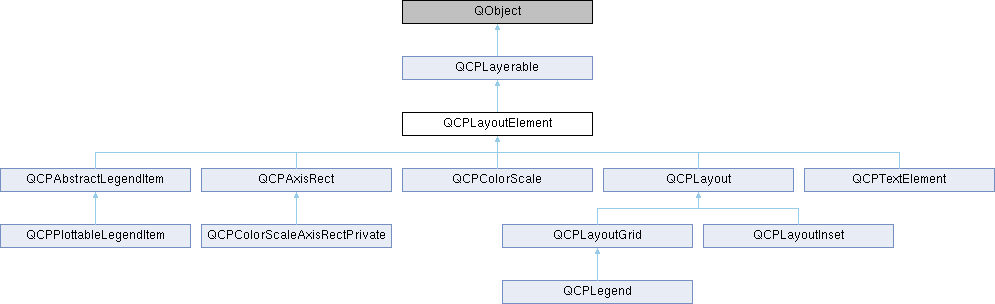
Public Types | |
| enum | UpdatePhase { upPreparation , upMargins , upLayout } |
| Defines the phases of the update process, that happens just before a replot. More... | |
| enum | SizeConstraintRect { scrInnerRect , scrOuterRect } |
| Defines to which rect of a layout element the size constraints that can be set via setMinimumSize and setMaximumSize apply. More... | |
Public Member Functions | |
| QCPLayoutElement (QCustomPlot *parentPlot=0) | |
| Creates an instance of QCPLayoutElement and sets default values. | |
| QCPLayout * | layout () const |
| Returns the parent layout of this layout element. | |
| QRect | rect () const |
| Returns the inner rect of this layout element. | |
| QRect | outerRect () const |
| Returns the outer rect of this layout element. | |
| QMargins | margins () const |
| QMargins | minimumMargins () const |
| QCP::MarginSides | autoMargins () const |
| QSize | minimumSize () const |
| QSize | maximumSize () const |
| SizeConstraintRect | sizeConstraintRect () const |
| QCPMarginGroup * | marginGroup (QCP::MarginSide side) const |
| QHash< QCP::MarginSide, QCPMarginGroup * > | marginGroups () const |
| void | setOuterRect (const QRect &rect) |
| Sets the outer rect of this layout element. | |
| void | setMargins (const QMargins &margins) |
| Sets the margins of this layout element. | |
| void | setMinimumMargins (const QMargins &margins) |
| If setAutoMargins is enabled on some or all margins, this function is used to provide minimum values for those margins. | |
| void | setAutoMargins (QCP::MarginSides sides) |
| Sets on which sides the margin shall be calculated automatically. | |
| void | setMinimumSize (const QSize &size) |
| Sets the minimum size of this layout element. | |
| void | setMinimumSize (int width, int height) |
| This is an overloaded member function, provided for convenience. It differs from the above function only in what argument(s) it accepts.Sets the minimum size of this layout element. | |
| void | setMaximumSize (const QSize &size) |
| Sets the maximum size of this layout element. | |
| void | setMaximumSize (int width, int height) |
| This is an overloaded member function, provided for convenience. It differs from the above function only in what argument(s) it accepts.Sets the maximum size of this layout element. | |
| void | setSizeConstraintRect (SizeConstraintRect constraintRect) |
| Sets to which rect of a layout element the size constraints apply. | |
| void | setMarginGroup (QCP::MarginSides sides, QCPMarginGroup *group) |
| Sets the margin group of the specified margin sides. | |
| virtual void | update (UpdatePhase phase) |
| Updates the layout element and sub-elements. | |
| virtual QSize | minimumOuterSizeHint () const |
| Returns the suggested minimum size this layout element (the outerRect) may be compressed to, if no manual minimum size is set. | |
| virtual QSize | maximumOuterSizeHint () const |
| Returns the suggested maximum size this layout element (the outerRect) may be expanded to, if no manual maximum size is set. | |
| virtual QList< QCPLayoutElement * > | elements (bool recursive) const |
| Returns a list of all child elements in this layout element. | |
| virtual double | selectTest (const QPointF &pos, bool onlySelectable, QVariant *details=0) const Q_DECL_OVERRIDE |
| Layout elements are sensitive to events inside their outer rect. | |
 Public Member Functions inherited from QCPLayerable Public Member Functions inherited from QCPLayerable | |
| QCPLayerable (QCustomPlot *plot, QString targetLayer=QString(), QCPLayerable *parentLayerable=0) | |
| Creates a new QCPLayerable instance. | |
| bool | visible () const |
| QCustomPlot * | parentPlot () const |
| QCPLayerable * | parentLayerable () const |
| Returns the parent layerable of this layerable. | |
| QCPLayer * | layer () const |
| bool | antialiased () const |
| void | setVisible (bool on) |
| Sets the visibility of this layerable object. | |
| Q_SLOT bool | setLayer (QCPLayer *layer) |
| Sets the layer of this layerable object. | |
| bool | setLayer (const QString &layerName) |
| This is an overloaded member function, provided for convenience. It differs from the above function only in what argument(s) it accepts. Sets the layer of this layerable object by name. | |
| void | setAntialiased (bool enabled) |
| Sets whether this object will be drawn antialiased or not. | |
| virtual double | selectTest (const QPointF &pos, bool onlySelectable, QVariant *details=0) const |
| This function is used to decide whether a click hits a layerable object or not. | |
| bool | realVisibility () const |
| Returns whether this layerable is visible, taking the visibility of the layerable parent and the visibility of this layerable's layer into account. | |
Protected Member Functions | |
| virtual int | calculateAutoMargin (QCP::MarginSide side) |
| virtual void | layoutChanged () |
| virtual void | applyDefaultAntialiasingHint (QCPPainter *painter) const Q_DECL_OVERRIDE |
| virtual void | draw (QCPPainter *painter) Q_DECL_OVERRIDE |
| virtual void | parentPlotInitialized (QCustomPlot *parentPlot) Q_DECL_OVERRIDE |
| Protected Member Functions inherited from QCPLayerable | |
| virtual void | parentPlotInitialized (QCustomPlot *parentPlot) |
| virtual QCP::Interaction | selectionCategory () const |
| virtual QRect | clipRect () const |
| virtual void | applyDefaultAntialiasingHint (QCPPainter *painter) const =0 |
| virtual void | draw (QCPPainter *painter)=0 |
| virtual void | selectEvent (QMouseEvent *event, bool additive, const QVariant &details, bool *selectionStateChanged) |
| virtual void | deselectEvent (bool *selectionStateChanged) |
| virtual void | mousePressEvent (QMouseEvent *event, const QVariant &details) |
| This event gets called when the user presses a mouse button while the cursor is over the layerable. | |
| virtual void | mouseMoveEvent (QMouseEvent *event, const QPointF &startPos) |
| This event gets called when the user moves the mouse while holding a mouse button, after this layerable has become the mouse grabber by accepting the preceding mousePressEvent. | |
| virtual void | mouseReleaseEvent (QMouseEvent *event, const QPointF &startPos) |
| This event gets called when the user releases the mouse button, after this layerable has become the mouse grabber by accepting the preceding mousePressEvent. | |
| virtual void | mouseDoubleClickEvent (QMouseEvent *event, const QVariant &details) |
| This event gets called when the user presses the mouse button a second time in a double-click, while the cursor is over the layerable. | |
| virtual void | wheelEvent (QWheelEvent *event) |
| This event gets called when the user turns the mouse scroll wheel while the cursor is over the layerable. | |
| void | initializeParentPlot (QCustomPlot *parentPlot) |
| void | setParentLayerable (QCPLayerable *parentLayerable) |
| bool | moveToLayer (QCPLayer *layer, bool prepend) |
| void | applyAntialiasingHint (QCPPainter *painter, bool localAntialiased, QCP::AntialiasedElement overrideElement) const |
Protected Attributes | |
| QCPLayout * | mParentLayout |
| QSize | mMinimumSize |
| QSize | mMaximumSize |
| SizeConstraintRect | mSizeConstraintRect |
| QRect | mRect |
| QRect | mOuterRect |
| QMargins | mMargins |
| QMargins | mMinimumMargins |
| QCP::MarginSides | mAutoMargins |
| QHash< QCP::MarginSide, QCPMarginGroup * > | mMarginGroups |
| Protected Attributes inherited from QCPLayerable | |
| bool | mVisible |
| QCustomPlot * | mParentPlot |
| QPointer< QCPLayerable > | mParentLayerable |
| QCPLayer * | mLayer |
| bool | mAntialiased |
Friends | |
| class | QCustomPlot |
| class | QCPLayout |
| class | QCPMarginGroup |
Additional Inherited Members | |
| Signals inherited from QCPLayerable | |
| void | layerChanged (QCPLayer *newLayer) |
| This signal is emitted when the layer of this layerable changes, i.e. | |
Detailed Description
The abstract base class for all objects that form the layout system.
This is an abstract base class. As such, it can't be instantiated directly, rather use one of its subclasses.
A Layout element is a rectangular object which can be placed in layouts. It has an outer rect (QCPLayoutElement::outerRect) and an inner rect (QCPLayoutElement::rect). The difference between outer and inner rect is called its margin. The margin can either be set to automatic or manual (setAutoMargins) on a per-side basis. If a side is set to manual, that margin can be set explicitly with setMargins and will stay fixed at that value. If it's set to automatic, the layout element subclass will control the value itself (via calculateAutoMargin).
Layout elements can be placed in layouts (base class QCPLayout) like QCPLayoutGrid. The top level layout is reachable via QCustomPlot::plotLayout, and is a QCPLayoutGrid. Since QCPLayout itself derives from QCPLayoutElement, layouts can be nested.
Thus in QCustomPlot one can divide layout elements into two categories: The ones that are invisible by themselves, because they don't draw anything. Their only purpose is to manage the position and size of other layout elements. This category of layout elements usually use QCPLayout as base class. Then there is the category of layout elements which actually draw something. For example, QCPAxisRect, QCPLegend and QCPTextElement are of this category. This does not necessarily mean that the latter category can't have child layout elements. QCPLegend for instance, actually derives from QCPLayoutGrid and the individual legend items are child layout elements in the grid layout.
Member Enumeration Documentation
◆ SizeConstraintRect
Defines to which rect of a layout element the size constraints that can be set via setMinimumSize and setMaximumSize apply.
The outer rect (outerRect) includes the margins (e.g. in the case of a QCPAxisRect the axis labels), whereas the inner rect (rect) does not.
- See also
- setSizeConstraintRect
| Enumerator | |
|---|---|
| scrInnerRect | Minimum/Maximum size constraints apply to inner rect. |
| scrOuterRect | Minimum/Maximum size constraints apply to outer rect, thus include layout element margins. |
◆ UpdatePhase
Defines the phases of the update process, that happens just before a replot.
At each phase, update is called with the according UpdatePhase value.
Member Function Documentation
◆ applyDefaultAntialiasingHint()
|
inlineprotectedvirtual |
Implements QCPLayerable.
◆ draw()
|
inlineprotectedvirtual |
Implements QCPLayerable.
◆ elements()
|
virtual |
Returns a list of all child elements in this layout element.
If recursive is true, all sub-child elements are included in the list, too.
- Warning
- There may be entries with value 0 in the returned list. (For example, QCPLayoutGrid may have empty cells which yield 0 at the respective index.)
Reimplemented in QCPLayout, QCPLayoutGrid, and QCPAxisRect.
◆ maximumOuterSizeHint()
|
virtual |
Returns the suggested maximum size this layout element (the outerRect) may be expanded to, if no manual maximum size is set.
if a maximum size (setMaximumSize) was not set manually, parent layouts use the returned size (usually indirectly through QCPLayout::getFinalMaximumOuterSize) to determine the maximum allowed size of this layout element.
A manual maximum size is considered set if it is smaller than Qt's QWIDGETSIZE_MAX.
The default implementation simply returns QWIDGETSIZE_MAX for both width and height, implying no suggested maximum size. Reimplementations may use their detailed knowledge about the layout element's content to provide size hints.
Reimplemented in QCPLayoutGrid, and QCPTextElement.
◆ minimumOuterSizeHint()
|
virtual |
Returns the suggested minimum size this layout element (the outerRect) may be compressed to, if no manual minimum size is set.
if a minimum size (setMinimumSize) was not set manually, parent layouts use the returned size (usually indirectly through QCPLayout::getFinalMinimumOuterSize) to determine the minimum allowed size of this layout element.
A manual minimum size is considered set if it is non-zero.
The default implementation simply returns the sum of the horizontal margins for the width and the sum of the vertical margins for the height. Reimplementations may use their detailed knowledge about the layout element's content to provide size hints.
Reimplemented in QCPLayoutGrid, QCPPlottableLegendItem, and QCPTextElement.
◆ outerRect()
|
inline |
Returns the outer rect of this layout element.
The outer rect is the inner rect expanded by the margins (setMargins, setAutoMargins). The outer rect is used (and set via setOuterRect) by the parent QCPLayout to control the size of this layout element.
- See also
- rect
◆ parentPlotInitialized()
|
protectedvirtual |
Reimplemented from QCPLayerable.
◆ rect()
|
inline |
Returns the inner rect of this layout element.
The inner rect is the outer rect (outerRect, setOuterRect) shrinked by the margins (setMargins, setAutoMargins).
In some cases, the area between outer and inner rect is left blank. In other cases the margin area is used to display peripheral graphics while the main content is in the inner rect. This is where automatic margin calculation becomes interesting because it allows the layout element to adapt the margins to the peripheral graphics it wants to draw. For example, QCPAxisRect draws the axis labels and tick labels in the margin area, thus needs to adjust the margins (if setAutoMargins is enabled) according to the space required by the labels of the axes.
- See also
- outerRect
◆ selectTest()
|
virtual |
Layout elements are sensitive to events inside their outer rect.
If pos is within the outer rect, this method returns a value corresponding to 0.99 times the parent plot's selection tolerance. However, layout elements are not selectable by default. So if onlySelectable is true, -1.0 is returned.
See QCPLayerable::selectTest for a general explanation of this virtual method.
QCPLayoutElement subclasses may reimplement this method to provide more specific selection test behaviour.
Reimplemented from QCPLayerable.
Reimplemented in QCPLayoutInset, QCPAbstractLegendItem, QCPLegend, and QCPTextElement.
◆ setAutoMargins()
| void QCPLayoutElement::setAutoMargins | ( | QCP::MarginSides | sides | ) |
Sets on which sides the margin shall be calculated automatically.
If a side is calculated automatically, a minimum margin value may be provided with setMinimumMargins. If a side is set to be controlled manually, the value may be specified with setMargins.
Margin sides that are under automatic control may participate in a QCPMarginGroup (see setMarginGroup), to synchronize (align) it with other layout elements in the plot.
- See also
- setMinimumMargins, setMargins, QCP::MarginSide
◆ setMarginGroup()
| void QCPLayoutElement::setMarginGroup | ( | QCP::MarginSides | sides, |
| QCPMarginGroup * | group | ||
| ) |
Sets the margin group of the specified margin sides.
Margin groups allow synchronizing specified margins across layout elements, see the documentation of QCPMarginGroup.
To unset the margin group of sides, set group to 0.
Note that margin groups only work for margin sides that are set to automatic (setAutoMargins).
- See also
- QCP::MarginSide
◆ setMargins()
| void QCPLayoutElement::setMargins | ( | const QMargins & | margins | ) |
Sets the margins of this layout element.
If setAutoMargins is disabled for some or all sides, this function is used to manually set the margin on those sides. Sides that are still set to be handled automatically are ignored and may have any value in margins.
The margin is the distance between the outer rect (controlled by the parent layout via setOuterRect) and the inner rect (which usually contains the main content of this layout element).
- See also
- setAutoMargins
◆ setMaximumSize() [1/2]
| void QCPLayoutElement::setMaximumSize | ( | const QSize & | size | ) |
Sets the maximum size of this layout element.
A parent layout tries to respect the size here by changing row/column sizes in the layout accordingly.
Whether this constraint applies to the inner or the outer rect can be specified with setSizeConstraintRect (see rect and outerRect).
◆ setMaximumSize() [2/2]
| void QCPLayoutElement::setMaximumSize | ( | int | width, |
| int | height | ||
| ) |
This is an overloaded member function, provided for convenience. It differs from the above function only in what argument(s) it accepts.Sets the maximum size of this layout element.
Whether this constraint applies to the inner or the outer rect can be specified with setSizeConstraintRect (see rect and outerRect).
◆ setMinimumMargins()
| void QCPLayoutElement::setMinimumMargins | ( | const QMargins & | margins | ) |
If setAutoMargins is enabled on some or all margins, this function is used to provide minimum values for those margins.
The minimum values are not enforced on margin sides that were set to be under manual control via setAutoMargins.
- See also
- setAutoMargins
◆ setMinimumSize() [1/2]
| void QCPLayoutElement::setMinimumSize | ( | const QSize & | size | ) |
Sets the minimum size of this layout element.
A parent layout tries to respect the size here by changing row/column sizes in the layout accordingly.
If the parent layout size is not sufficient to satisfy all minimum size constraints of its child layout elements, the layout may set a size that is actually smaller than size. QCustomPlot propagates the layout's size constraints to the outside by setting its own minimum QWidget size accordingly, so violations of size should be exceptions.
Whether this constraint applies to the inner or the outer rect can be specified with setSizeConstraintRect (see rect and outerRect).
◆ setMinimumSize() [2/2]
| void QCPLayoutElement::setMinimumSize | ( | int | width, |
| int | height | ||
| ) |
This is an overloaded member function, provided for convenience. It differs from the above function only in what argument(s) it accepts.Sets the minimum size of this layout element.
Whether this constraint applies to the inner or the outer rect can be specified with setSizeConstraintRect (see rect and outerRect).
◆ setOuterRect()
| void QCPLayoutElement::setOuterRect | ( | const QRect & | rect | ) |
Sets the outer rect of this layout element.
If the layout element is inside a layout, the layout sets the position and size of this layout element using this function.
Calling this function externally has no effect, since the layout will overwrite any changes to the outer rect upon the next replot.
The layout element will adapt its inner rect by applying the margins inward to the outer rect.
- See also
- rect
◆ setSizeConstraintRect()
| void QCPLayoutElement::setSizeConstraintRect | ( | SizeConstraintRect | constraintRect | ) |
Sets to which rect of a layout element the size constraints apply.
Size constraints can be set via setMinimumSize and setMaximumSize.
The outer rect (outerRect) includes the margins (e.g. in the case of a QCPAxisRect the axis labels), whereas the inner rect (rect) does not.
- See also
- setMinimumSize, setMaximumSize
◆ update()
|
virtual |
Updates the layout element and sub-elements.
This function is automatically called before every replot by the parent layout element. It is called multiple times, once for every UpdatePhase. The phases are run through in the order of the enum values. For details about what happens at the different phases, see the documentation of UpdatePhase.
Layout elements that have child elements should call the update method of their child elements, and pass the current phase unchanged.
The default implementation executes the automatic margin mechanism in the upMargins phase. Subclasses should make sure to call the base class implementation.
Reimplemented in QCPLayout, QCPAxisRect, QCPColorScaleAxisRectPrivate, and QCPColorScale.
The documentation for this class was generated from the following files:
- qcustomplot.h
- qcustomplot.cpp
